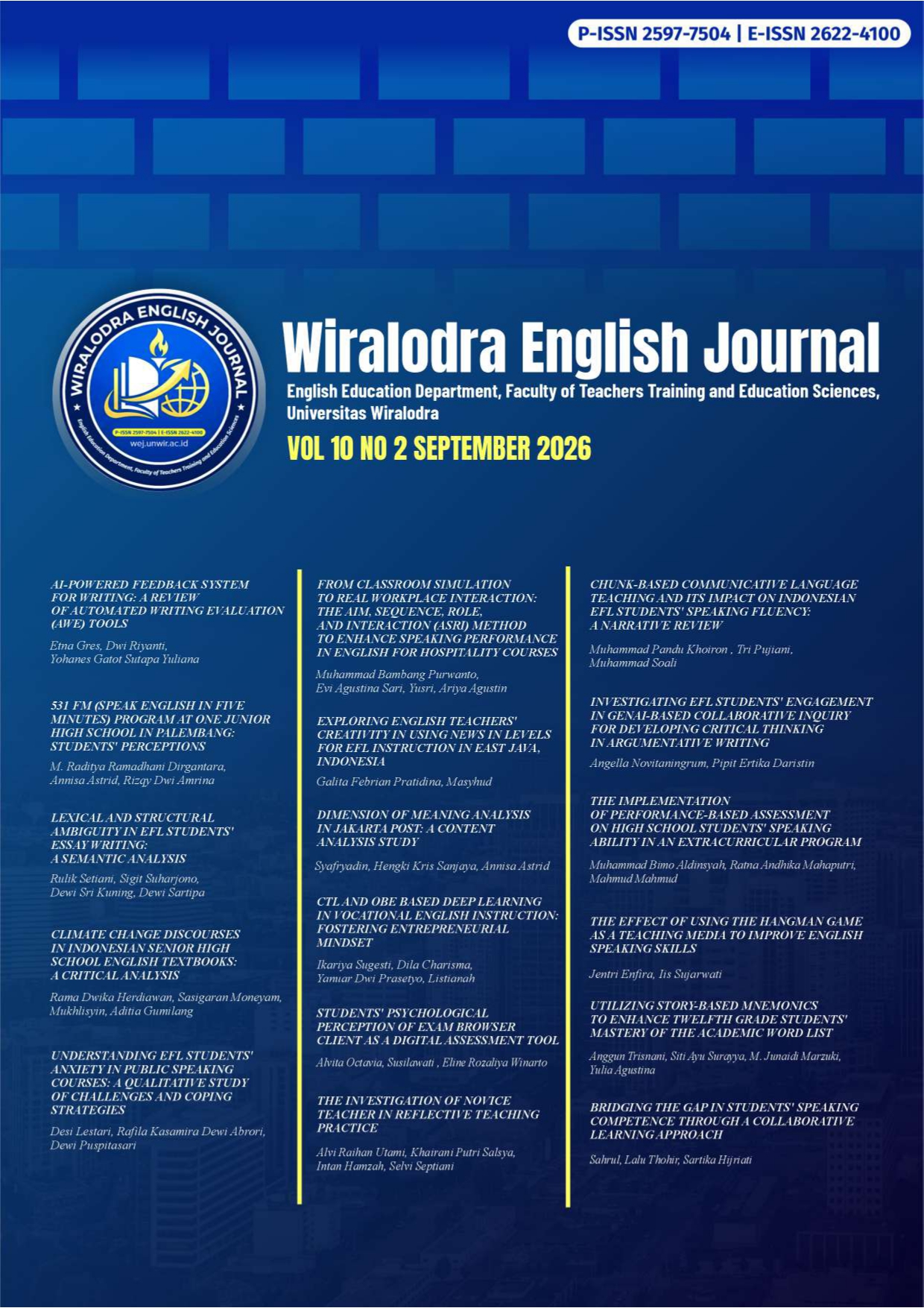
CLIMATE CHANGE DISCOURSES IN INDONESIAN SENIOR HIGH SCHOOL ENGLISH TEXTBOOKS: A CRITICAL ANALYSIS
DOI:
https://doi.org/10.31943/wej.v10i2.676Keywords:
Climate Change, Critical Discourse Analysis, EFL Textbooks, Environmental Literacy, Learner PositioningAbstract
This study examines how climate change is represented in two Indonesian senior high school English textbooks and how the representations position learners in relation to environmental responsibility. A qualitative document analysis was conducted using Fairclough’s three-dimensional Critical Discourse Analysis framework. The corpus comprised climate-related reading passages, activity prompts, dialogues, and visual-verbal materials in the 2017 revised Bahasa Inggris for Grade XI and the 2022 English for Change for Grade XI. The analysis identified four interrelated patterns. First, climate change was factualized through declarative and causal language but was frequently simplified into non-conflictual explanations. Second, responsibility was directed mainly toward students, families, communities, and youth activists, while governmental, corporate, and industrial actors were backgrounded. Third, the activities promoted awareness and participation, yet only limited opportunities were provided for examining competing interests, unequal vulnerability, or climate justice. Fourth, optimistic portraits and clean environmental imagery softened the crisis while reinforcing hopeful action. The findings imply that EFL textbooks should retain accessible language while expanding structural accountability, local climate realities, dialogic tasks, and critical visual literacy so that language learning supports both communicative competence and critical environmental literacy.
Downloads
Downloads
Published
How to Cite
Issue
Section
License
Copyright (c) 2026 Rama Dwika Herdiawan, Sasigaran Moneyam, Mukhlisyin, Aditia Gumilang

This work is licensed under a Creative Commons Attribution 4.0 International License.