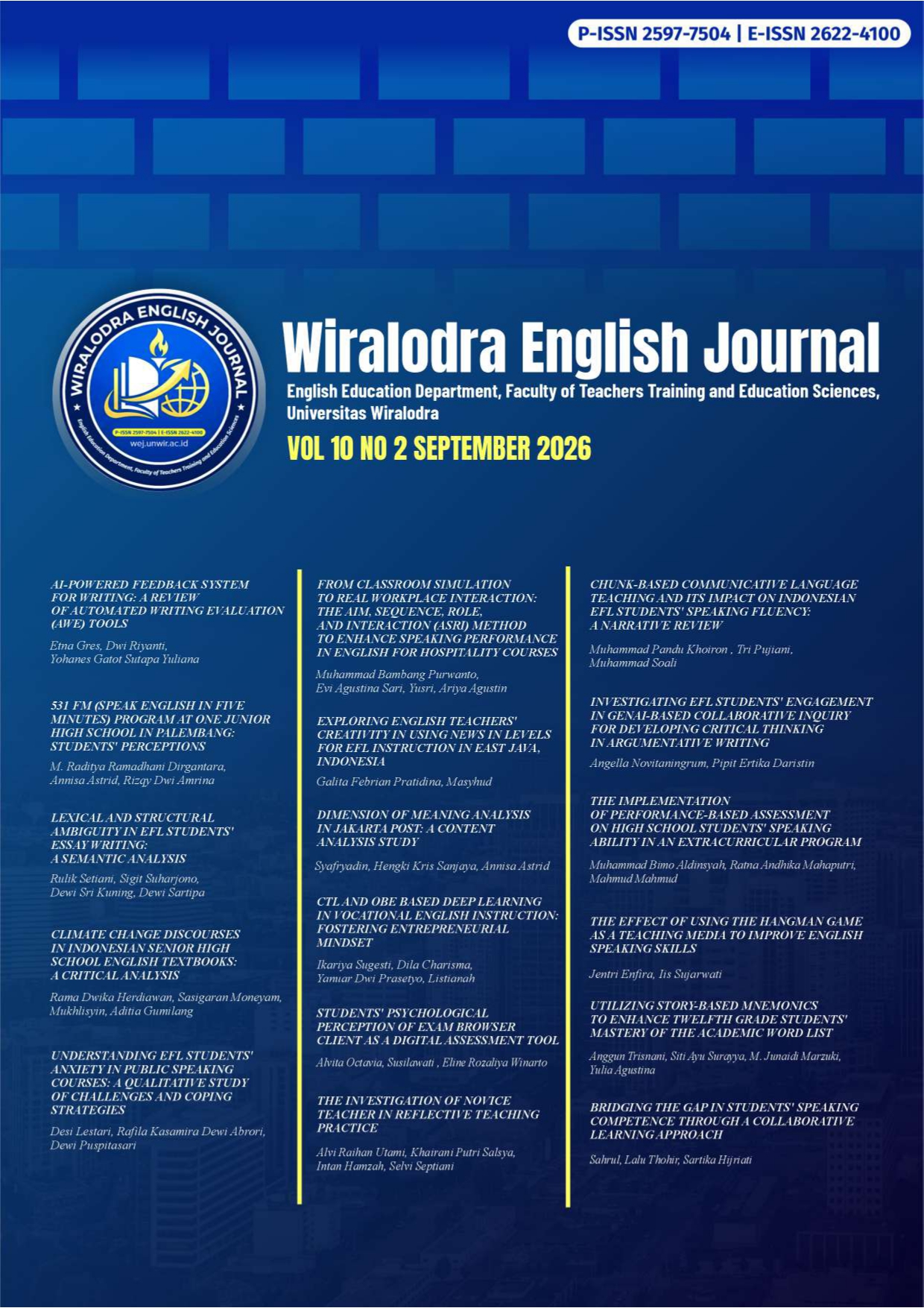
FROM CLASSROOM SIMULATION TO REAL WORKPLACE INTERACTION: THE AIM, SEQUENCE, ROLE, AND INTERACTION (ASRI) METHOD TO ENHANCE SPEAKING PERFORMANCE IN ENGLISH FOR HOSPITALITY COURSES
DOI:
https://doi.org/10.31943/wej.v10i2.724Keywords:
ASRI Method, English for Specific Purposes, Hospitality English, Quasi-Experimental, Speaking PerformanceAbstract
This study investigates the effectiveness of the Aim, Sequence, Role, and Interaction (ASRI) method in improving the English-speaking performance of hospitality students in vocational higher education. Extending previous applications conducted primarily in tourism-dominant settings such as Bali, this study examines ASRI in a non-tourist city context, thereby contributing to the ESP instructional literature. A quasi-experimental design with pre-test and post-test measurements was employed with 30 fourth-semester students from two classes at Politeknik Prasetiya Mandiri PSDKU Palembang, South Sumatra, Indonesia. The experimental group received ASRI-based instruction through six structured sessions, whereas the control group received conventional role-play instruction. Speaking performance was assessed in terms of fluency, accuracy, pronunciation, vocabulary, and confidence. The findings revealed a statistically significant improvement in the experimental group, accompanied by a very large effect size. Among the assessed components, confidence and vocabulary demonstrated the most substantial gains, suggesting that ASRI effectively facilitates professionally contextualized and goal-directed communication. These findings indicate that ASRI offers a replicable framework for developing workplace-oriented English communication skills among vocational hospitality students. Nevertheless, the study is limited by its small sample and single-institution setting, highlighting the need for broader multi-institutional research.
Downloads
Downloads
Published
How to Cite
Issue
Section
License
Copyright (c) 2026 Muhammad Bambang Purwanto, Evi Agustina Sari, Yusri Yusri, Ariya Agustin

This work is licensed under a Creative Commons Attribution 4.0 International License.