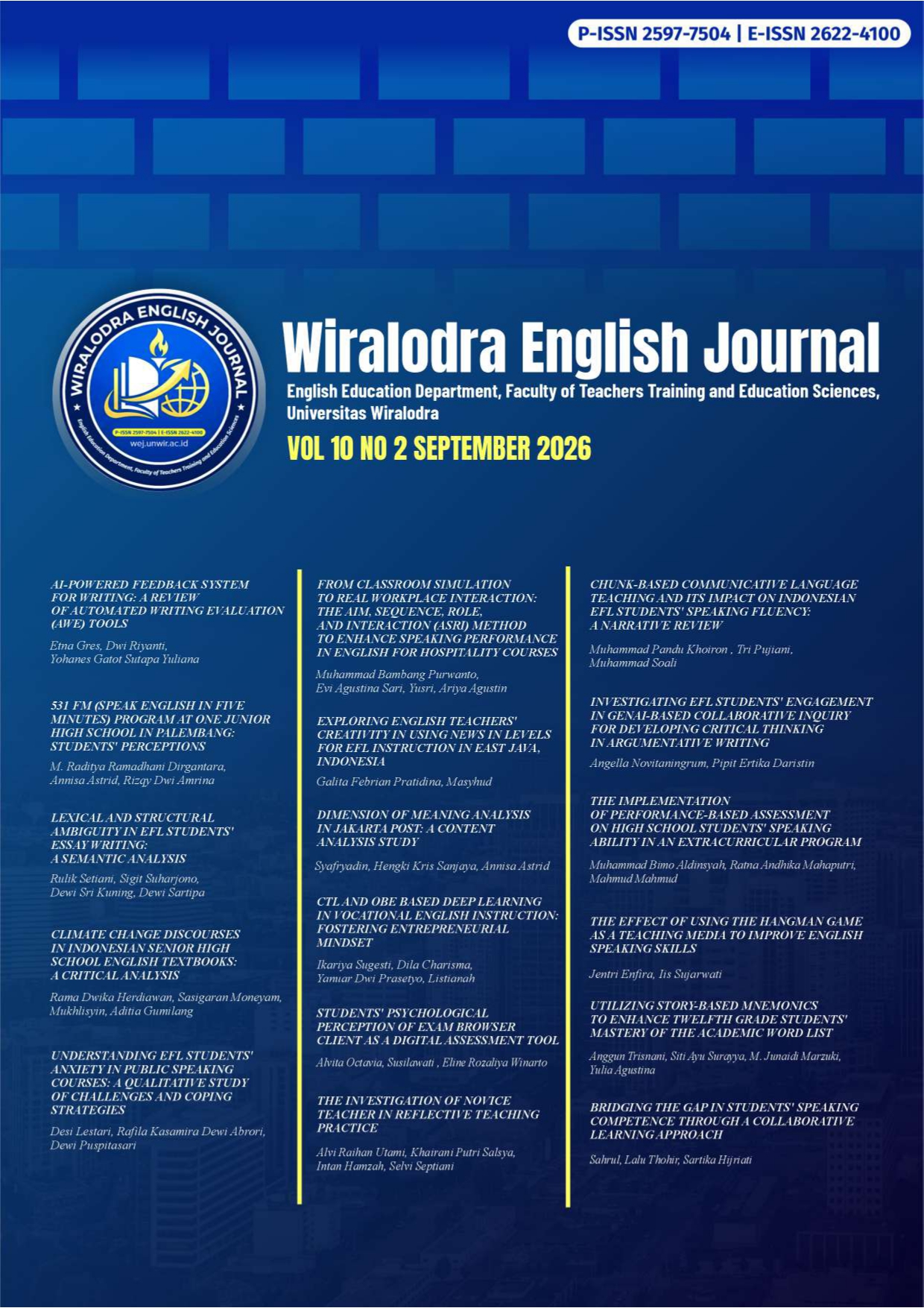
CHUNK-BASED COMMUNICATIVE LANGUAGE TEACHING AND ITS IMPACT ON INDONESIAN EFL STUDENTS’ SPEAKING FLUENCY: A NARRATIVE REVIEW
DOI:
https://doi.org/10.31943/wej.v10i2.744Keywords:
Communicative Language Teaching, EFL, Indonesian Students, Lexical Chunks, Speaking FluencyAbstract
The current narrative literature review aimed to investigate the use of Chunk-Based CLT as a pedagogical technique to enhance the fluency of EFL students from Indonesia. Even though the students have been receiving formal English education in all stages from primary to tertiary levels, many still experience difficulties in their fluency due to the high cognitive load and their tendency to translate from word to word. In order to explore this problem, the literature synthesis was performed using academic works related to formulaic language and communicative pedagogy. It turned out that lexical chunks (prefabricated formulaic sequences) help learners acquire important cognitive shortcuts and minimize unnatural pausing, increase speech rate and reduce the anxiety about making grammatical mistakes during language learning in a foreign language. Besides, engaging the learners with these linguistic units in communicative activities is beneficial for producing natural speech. Thus, the pedagogical relevance of this method of instruction in EFL context is highly significant. Based on the findings made, this paper shows that the chunk-based instruction is useful in bridging the fluency gap. To continue this research, further empirical studies need to be performed experimentally.
Downloads
Downloads
Published
How to Cite
Issue
Section
License
Copyright (c) 2026 Muhammad Pandu Khoiron, Tri Pujiani, Muhammad Soali

This work is licensed under a Creative Commons Attribution 4.0 International License.